Mariana S. Țăranu
On 3 January 1949, Grigorii Orghian of Ursoaia wrote to Stalin, addressing him as father, friend and teacher. After this greeting, he explained that he had transferred his land to the collective farm but was still required to deliver grain as though he retained it. He had bought wheat to fulfil his obligations, and now another quantity was being demanded that he did not know how to obtain. He was 73 and asked to be removed from the list of “kulaks”. This was another letter: he said he had received no reply to the previous one. [1, pp. 84–85]
How should we read such an address? As evidence of love for Stalin? As an expression of fear? As a final attempt to secure survival?
My answer is that the letter must be read in its entirety. Its opening formula and the ordeal it describes belong to the same document. The writer cast the leader as a protector at the very moment he was describing the consequences of that leader's regime.
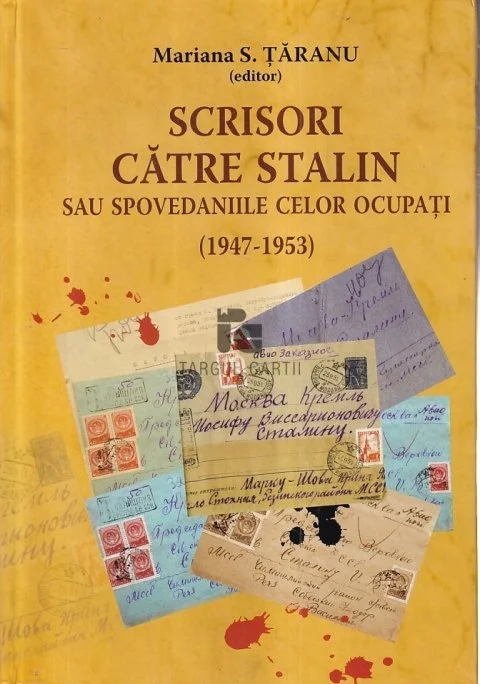
In Scrisori către Stalin sau spovedaniile celor ocupați (1947–1953) (“Letters to Stalin, or the Confessions of Those under Occupation”), I published 280 letters from the holdings of the National Archives of the Republic of Moldova. My research examines how ordinary people experienced Sovietisation and attempted to defend their families, households and place in society. I argue that these letters reveal both hope for intervention and the dependency created by a power that controlled the conditions of survival. [1, pp. 17–22]
The distant leader as an imagined final authority
To a letter writer, Stalin could appear to be the authority capable of stopping an abuse. A village official had seized property, imposed taxes or declared someone a “kulak”; the leader in the Kremlin needed to learn what had happened and put it right. This separation between supreme authority and wrongdoing on the ground offered a bearable explanation and somewhere to direct hope.
But historians cannot adopt this separation as an explanation of the system. A petitioner's presentation of Stalin as a saviour does not place Stalin outside the policies of collectivisation and repression. In my interpretation, the leader's cult made it possible for people to seek protection at the summit of the very power that threatened their existence. [1, pp. 18–25]
Sheila Fitzpatrick has highlighted the diversity of correspondence addressed to Soviet power: complaints, appeals, denunciations and personal accounts. [4] This perspective helps me avoid reducing all letters to a single attitude. For Soviet Moldova, I emphasise the conditions in which a population subjected to Sovietisation had to formulate requests to the new authorities.
Sincere belief, caution and calculation could coexist. Sometimes a writer might believe that Stalin did not know about their case. Sometimes they might use the expected language because it offered a chance of being heard. An opening formula alone cannot measure inner conviction.
An entire life became an argument
Gheorghe Chirița of Cojușna began his petition of 5 December 1948 by presenting his own life and family. He explained that he and his wife had worked in agriculture, listed their possessions and land, and rejected the accusation that he had exploited other people's labour. At 71, he challenged his classification as a “kulak” and requested an investigation under Soviet legislation and the USSR's Constitution. [1, pp. 65–67]
This autobiography was not a digression. It was the argument through which the writer sought to demonstrate that the administration had assigned him a false identity. His age, work and household inventory had to answer a political label with material consequences.
In these letters, “kulak” does not simply mean a prosperous person. It is an administrative and political category associated by the regime with exploitation, one that could bring increased obligations, confiscation and deportation. That is why the question “who am I?” became a matter of survival. [1, pp. 23–25]
For me, what is at stake in these autobiographies is people's right to say who they had been before power redefined them. They invoked their own labour, the children they supported, military service or assistance given to others. Every detail was intended to restore them to the category of those deserving protection.
In her research on letters from Soviet youth, Juliane Fürst shows that such texts could affirm the system while also testifying to its failures. [5] In the letters I published, I trace the same tension, but in the experiences of people with different biographies and relationships to Soviet power. The language of loyalty could accompany the description of a ruined life.
A letter could return to those it accused
People wrote to Moscow to escape a local impasse. Yet the letter's administrative journey could take them straight back into it.
In the introduction to my collection, I describe the route identified in the documents examined: registration in Moscow, referral to the Council of Ministers in Chișinău, and subsequent investigation through district executive committees and village soviets. We should not assume that every letter followed all these stages identically, but this mechanism explains why an appeal to the leader did not mean personal consideration by him. [1, pp. 19–20, 25]
Leon Pădurar of Chișcăiești reported that his petition to the chairman of the Moldavian SSR's Council of Ministers had been forwarded to the district executive committee, which rejected his request again. He alleged that he had been listed as a “kulak” in retaliation for refusing to give an official wine, and asked Stalin to investigate. The letter was registered on 11 January 1949. [1, p. 81]
The document contains an allegation that must be tested against other sources. It directly establishes, however, how the petitioner described his blocked request and understood his relationship with the authorities.
Referring a complaint for local examination could bring the writer's name and allegations to the officials being criticised. This also informs my interpretation of cautious wording: a person needed to say enough to request help without turning the petition into a direct challenge to the entire system of power. This risk does not prove that every letter led to reprisals; each case must be traced.
Food, a pension and dignity
The problems described in the letters were not confined to the classification of households. People requested food, housing, pensions and permission to remain at home. Behind administrative language lay a concrete question: what will I live on?
The connection with my research on famine is direct. In RSSM în anii foametei staliniste (1946–1947): între teroarea politică și drama supraviețuirii (“The Moldavian SSR during the Stalinist Famine: Between Political Terror and the Struggle for Survival”), I examine how compulsory deliveries and pressure on households restricted family resources. The letters allow us to trace this pressure through the voices of those subjected to it, including beyond the famine years. [2, pp. 44–68; 1, pp. 84–85]
In a letter dated 20 August 1949, Maria Nichifor of Călărași described her many years caring for the sick and helping Soviet servicemen. She reported confiscations, humiliation and the suspension of her pension. What was at stake was not only the lack of means to live, but dignity: how could a life of work and assistance to others meet with such treatment? She ended by asking for her pension payments to resume and for a reply. [1, pp. 201–208]
I am interested in this relationship between recognition and survival. People were not always asking only for a material benefit. They asked for their work, age and suffering to be recognised, and for the right not to be treated as enemies.
Hope alone cannot tell us what happened after a letter
For Sergei Berlinschii, who in December 1948 requested removal from the “kulak” list and admission to a collective farm, the documentary note in my collection records his deportation with his family to the Kurgan region in July 1949. [1, p. 69 and note 40]
This case shows the limits of the protection sought through a letter. It does not establish that writing the letter caused the deportation. Such a connection would require documents concerning the decision and its grounds.
Similarly, the existence of a letter addressed to Stalin does not prove that he read it personally. Nor does the absence of a reply in the documents consulted automatically establish that no reply ever existed. In my research, I distinguish between what the person requested, the document's journey and the fate we can reconstruct.
Writing meant trying to preserve life and a place in society
Why did people write to Stalin? Because they still hoped for intervention, sought to bypass local authority and needed food, protection and recognition. Fear did not erase this initiative; it shaped its language.
My position is that these letters must be read as evidence of attempts to act within a profoundly unequal relationship. They show people defending their lives through arguments that power might accept. At the same time, they document the human cost of the Soviet order that their authors had to invoke when seeking help.
Scrisori către Stalin is the foundation of this research. Alongside my monograph on famine and the documents and testimonies in Un genocid nerecunoscut (“An Unrecognised Genocide”), this collection supports the direction of my blog: explaining the mechanisms of Soviet domination through sources and the experiences of the people subjected to them. [3]
At the beginning of his letter, Grigorii Orghian called Stalin a protector. At its end, he again asked to be heard. Between these two moments lies the question I put to the documents: what kind of power forced people to seek salvation from the very leader of the regime that threatened them?
Quellen
[1] Mariana S. Țăranu (editor), Scrisori către Stalin sau spovedaniile celor ocupați (1947–1953), Chișinău, Pontos, 2014. Pasajele citate: introducerea, pp. 17–22; analiza clasificării gospodăriilor și a petițiilor, pp. 23–25; scrisoarea nr. 7, Gheorghe Chirița, pp. 65–67; scrisoarea nr. 9, Serghei Berlinschii, p. 69, inclusiv nota 40 privind deportarea; scrisoarea nr. 18, Leon Pădurar, p. 81; scrisoarea nr. 21, Grigorii Orghian, pp. 84–85; scrisoarea nr. 94, Maria Nichifor, pp. 201–208. Cotele indicate în ediție pentru Chirița: ANRM, F. 2848, inv. 7, dos. 75, f. 91–92; pentru Pădurar: ANRM, F. 2848, inv. 7, dos. 75, f. 396–396 verso; pentru Nichifor: ANRM, F. 2848, inv. 7, dos. 90, f. 91–93.
[2] Mariana S. Țăranu, RSSM în anii foametei staliniste (1946–1947): între teroarea politică și drama supraviețuirii, Chișinău, Lexon-Prim, 2026, pp. 44–68. ISBN 978-9975-181-42-6.
[3] Mariana S. Țăranu (editor), Un genocid nerecunoscut, București, Editura Vremea, 2020. Volum de documente și mărturii despre foametea din 1946–1947; pentru prezentarea proiectului și a interpretării autoarei, pp. 15–18.
[4] Sheila Fitzpatrick, „Supplicants and Citizens: Public Letter-Writing in Soviet Russia in the 1930s”, Slavic Review, vol. 55, nr. 1, 1996, pp. 78–105. DOI: https://doi.org/10.2307/2500979. Prezentarea tipurilor de corespondență: extrasul publicat de Cambridge University Press, https://www.cambridge.org/core/journals/slavic-review/article/abs/supplicants-and-citizens-public-letterwriting-in-soviet-russia-in-the-1930s/0BD419014B078A95B7B755E30F4122C0
[5] Juliane Fürst, „In Search of Soviet Salvation: Young People Write to the Stalinist Authorities”, Contemporary European History, vol. 15, nr. 3, 2006, pp. 327–345. DOI: https://doi.org/10.1017/S0960777306003353. Argumentul despre afirmarea sistemului și mărturisirea eșecurilor sale: rezumatul publicat de Cambridge University Press, https://www.cambridge.org/core/journals/contemporary-european-history/article/in-search-of-soviet-salvation-young-people-write-to-the-stalinist-authorities/FEF52E4344B00E5CE5EEF68404509D8F